
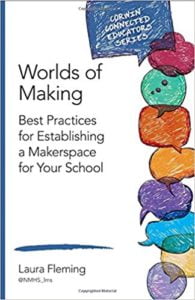
Fleming’s book is an attempt at giving school leaders and teachers a how-to guide on setting up a physical makerspace in the school. It includes chapters on the history of the maker movement, planning the space, setting up the space, creating maker culture in the school, integrating standards, bringing in community experts, reinventing the library as a makerspace, being a unique learning environment, showing student’s work, using them to change the future, and the school leader’s role. Overall, Worlds of Making, is a must read for those who are intending on creating a makerspace, within or outside of a school setting.
Worlds of Making is part of a series of short books intended on encouraging tech in schools called Corwin Connected Educator Series. At the time the book was written, Fleming had been an educator in New Jersey for 17 years as a classroom teacher and media specialist in K-8 schools and as a library media specialist in 9-12. She was also 2014’s “20 to Watch” in technological leadership by the National School Board. Other teachers interested in creating a makerspace began asking her about budgets, purchasing, set-up, and facilitation, so she decided to write a book about it. Learn more about her work at Worlds of Learning and Worlds of Making and follow her on Twitter.
Here is an overview of the golden nuggets to expect from the book. It defines the school makerspace as a “place where young people have an opportunity to explore their own interests; learn to use tools and materials, both physical and virtual; and develop creative projects (pg. 5).” It should also not only meet the needs of the teachers, leaders, and standards, but also the needs of the students. Planning the makerspace should come before the purchasing of materials, and this committee is to include a variety of people such as teachers, tech support, leaders, and especially students. The maker mindset is important for all, teachers and students, which means to be open to try new things, be open to failure, and to be persistent with
learning more about what you were curious to find out in the first place. IT IS OKAY AS THE TEACHER TO NOT KNOW WHAT YOU ARE DOING! Standards are able to be aligned to maker activities, a statement we at HES find very true as it is what we do. Community maker experts are a great resource in order to inspire students to see that there is a wide variety of career and hobby options out there. Libraries can be revived by using them as a makerspace. And last but not least, innovation will only be effective if there is support from the school leaders, including giving trust and autonomy to teachers.
Worlds of Making did a great job at pointing out what I hear all the time about integrating maker education into the school day. If you, or someone you know, is scared of bringing making into the classroom because they think they need to be an expert at it before they teach it, that it is just an extra curricular and can’t be used to teach the standards, there is no space, or they just don’t know where to begin, then this is a great quick read to get you started.
I do wish it talked more about resources on integrating standards into maker projects. However, I assume the availability is still low as I am aware the scarcity of finding this information, hence why I started HES. And another subject I wished the book touched more on is assessment. But again, I don’t blame her as we researchers in maker education are just now able to get to that part of this wonderful pedagogy. And she does talk a bit more about it in one of her blog posts using digital badges.
Overall, I am blown away at the quality of information provided in this book with only 65 pages. Teachers are busy, so I assume it is a good thing to have a quick read to get started. I look forward to learning more both from the series as well as her other book, The Kickstart Guide to Making GREAT Makerspaces (Corwin Teaching Essentials)*. I will also strive to be more like her, and create useful content on equitable and sustainable cross-curricular maker activities for teachers nation, and maybe even world, -wide.
*Affiliated links help support us in the continuation of providing quality information.