
Over the course of this school year, I have been volunteering with KFS School to help them plan an implementation of a makerspace, NGSS and Common Core aligned maker education/STEAM curriculum, and aiding with the parental support of the program. This reflection will be focusing on my most recent 2 hour session at the school, 1 hour with the lead teacher and 1 hour with the parents regarding this work.
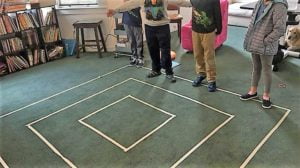 KFS School is a small K-8 school in the city serving students with behavioral needs a quality educational program. During this session, I met with the lead teacher, Nora Richman, to discuss a unit that was just taught by their teacher as well as the initial meeting to introduce Google Classrooms to make their STEAM curriculum easier to implement. The hope of using Google Classroom is to flip the classroom and let the students listen to instruction as little or as often as the individual students needs, work on the project when they are ready, and go back or move ahead as they need. This allows the teacher to be there to help the student as needed, rather than having stop instruction anytime a student needs clarification or redirection, causing the other students to wait were they may get bored, which may open the room to a behavioral incident or just a difficulty in moving forward once you have lost the class. This situation probably sounds familiar to most teachers, not just a special needs teacher.
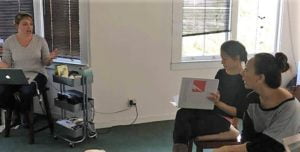
Later, I discussed with the parents during our advisory meeting about the design and collaboration class, the units coming up, and the transition into Google Classrooms. As expected, the parents were excited and had many questions on how this would work. There was some concern to get the transition rolling sooner, but I assured them that the transition should happen at a slow pace in order to limit the anxiety change can bring to teachers, students, and parents. I explained how schools that implemented technology too quickly without a support plan usually backfired due to the process being overwhelming. Overall, the parents seemed excited to learn more and get the process rolling.
I felt positive that a school is willing to take a chance and try to create an environment where maker education may work for them. I have taught maker classes for years, and even in non-behavioral classes the mix of instruction, clarification, and doing is difficult to manage in the classroom as each student works at their own pace. My classroom was mostly full of bored students ready for the next step or students who needed more time with the previous step and very few who were “at pace”. I think that the students have the right to work at these separate paces, it is us, the educators, who need to adjust how they receive their instruction to work for them.
The positive aspect of the teacher and parent meetings were the excitement from everyone about implementing positive change. Many parents and teachers are looking for new ways for our students to learn more effectively and we are all on board that experiential education has many benefits for students with behavioral needs just as well as anyone else. There are some bumps in the road, for example learning how to write a manual for teachers is new to me. I am used to teaching maker education myself, so when a problem arises I use the tools stuck in my own brain in order to pivot the lesson and get the activity rolling again. But knowing how to dump these strategies that are in my brain effectively and not causing information overload to the teacher is hard. So many things can go “wrong” in a class and I am learning how to communicate strategies as I go along and learn from my collaborators experiences. I am lucky in this instance, the current teacher teaching the STEAM class at KFS School, Josue Zamora, is great on their feet and understands the tinkering concept of seeing a “problem” as a new challenge for the students to learn to overcome.
Just as we maker educators teach our students that it is okay to make mistakes because we learn from them, I also keep telling myself the same. My teaching the teacher skills will hopefully improve as I go through the testing phase of the design process myself, and I also will hopefully continue to listen well during the empathy phase as I need to learn more about the needs of the teachers I am working with. I will continue to make adjustments and provide a better prototype everytime, and I will continue to see this process as a prototype because I don’t see this work as ever actually done. It is just a better version than the last one.