
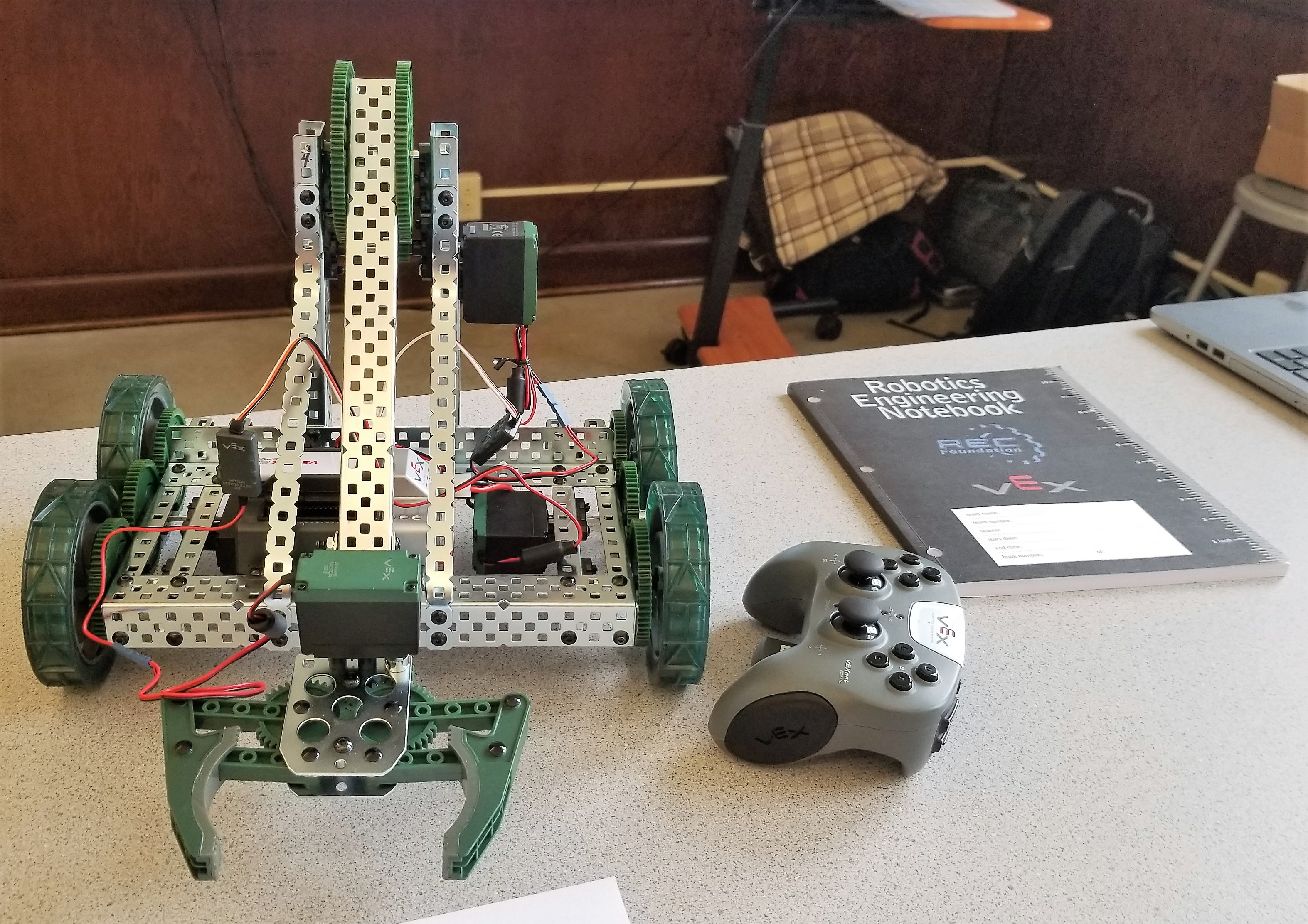
 Holy Names High School (HNHS) is an all-girls school in the hills of Oakland and part of the educational ministry of the Sisters of the Holy Names. They have partnered with Project Lead the Way’s Engineering Design and Computer Science programs which provides teacher training as well as curriculum support. During the half week before they go back to regular classes, HNHS holds a mid-session intensive with options to participate in an internship, camping and hiking, or workshops at school such as (but not limited to) stained glass making, theatrical make-up, zines, and robotics. These options are for 5 hours a day from Wednesday to Friday. The goal of the robotics class, in which I volunteered, was to teach their students how to build the Vex EDR robot, maneuver the robot with the remote control (RC), and to program the robot to do tasks using the language RobotC and write about the process in their engineering journals. .
My original intention was to write about the implementation of the curriculum related to maker ed, however, I was moved to change my focus to discuss gender in maker ed programs instead. Going into the school, I was skeptical about the long-term effects of an all-girls school, and even more so regarding an all-girls robotics program. This is because I have assumed that placing girls in a single gender school would not teach them the right tools to know how to communicate and collaborate with boys, and even more so in a male dominated field such as robotics. I also had a strong belief that girls should attend STEAM programs that include boys for the benefit of boys as well, teaching them that it is normal for girls to be in these programs too, not the exception.
To give some background on my perspective, let me tell you some of my observations while teaching maker ed. When I teach so-called “boy” subjects such as programming and engineering, my female students are more than likely to either assume they have no interest or be interested but less vocal than the plethora of excited male students and quickly quiet their enthusiasm even more. I don’t think this is nature, but nurture that has created this bias. For example, I once taught a building with Legos workshop at a museum, a parent came up to me and exclaimed how much they loved this program for their son, however, wanted to know if I had “girl Legos” so their daughter can participate as well. And as an extreme example, recently a boy asked me to help set up a drone they got. However, their grandfather immediately asked them, “why are you asking a stewardess how to fly a plane, you should be asking a pilot.” I asked why was I considered the stewardess in this scenario and why couldn’t I be the pilot, and he blatantly said because I was a girl. I am going to assume the best and this was meant to be a joke, however, it wasn’t a good joke and probably mirrors his true feelings. The boy seemed to ignore this comment, and continued to work with me until he got the drone to fly.
These examples are why I have been a strong promoter of co-ed programs, in the hopes that more people like the boy with the drone will continue to ignore inappropriate gender biases, and see females working in so-called “boy” fields as normal. To clarify, I see this as a gender issue, not an issue where females are the only victim. One, it is equally not fair to boys to not learn to work with girls, and two, boys also deserve to learn how to do so-called “girl” tasks as well. I teach sewing and cooking, which modern history deems as “girl” tasks, however, boys in my classes have often enjoyed and thrived at these activities.
My mind regarding single-gendered programs as being detrimental was changed during this volunteer experience. During this program I saw a classroom full of students who were interested and enthusiastic to accomplish building, maneuvering, and programming their robots. I began to think why I was surprised, it wasn’t because the girls were capable, I know that already, I was surprised to see the girls not hindered by whether if they are capable. Is this because they are in a situation where past taught gender stereotypes aren’t being played out because they don’t exist in a single-gendered school? Maybe, according to the National Coalition of Girls’ Schools say that alumnae of single-sex schools are three times more likely to plan to become engineers.
On the first day of robotics, students in groups of 2 were given a box with an inventory sheet. There were 4 teachers who were explicitly described as coaches for the session, and told the students that they are there for them, but they cannot touch anything, meaning the students had to do the work themselves aka no helicopter teaching. They had to go through and first make sure they had all their parts and know them by their names. Then they had to follow instructions to put the robot together. This was not a simple as it looked for the students, however, they persevered and completed the task by tinkering, getting it wrong sometimes, starting over, and eventually figured it out. Half of the class finished by the end of the day, with some time to sync their RC.
The second day, students finished building if they needed, then synced their RC to begin practice. Their task was to follow a maze the coaches made without touching the boundaries, pick up cones, drop cones in a bin, and park the robot at the end. The task was more difficult to control than the students thought, but again, they kept at it and learned they got better with practice. It was fun to watch them compete with each other and laugh at themselves when they had a hard time learning how to grab and hold on to a cone.
On the third day, students began learning to program in RobotC. Originally it was planned that they would use a block based programming first to get started, but a better tutorial was found and students actually wrote out the code themselves, which they were very adept to do. Usually, if a student is new to programming, I like block based for any age first in order to comprehend the task, then move to typing it out yourself to practice syntax and learning to debug your mistakes. However, HNHS students seemed to not have too much issue starting out with typing the code first. Their tasks were to move the robot forward, back, turn left and right, make a square, and do a dance. The students did an amazing job at tinkering with different options in the code to make the robot do what they needed, and even found out that while they can’t type in a degree for the robot to turn to, they came up with their own method to get it to turn as needed (future ratio integration opportunity?).
Overall, the teachers did a great job at being a coach and encouraging the students to figure out their problems on their own and only providing minimal guidance. This is hard for teachers, as it is so easy to just give the answer, and more difficult but creates better connection of concept for the student to guide them without an answer. The students all worked hard, none of them said that they couldn’t or didn’t want to do it, instead they all seemed to see this as a challenge they wanted to solve. The school is planning on doing two robotic competitions in the Fall, this mid session was a prep for that competition and they plan to continue to practice before their meet.
Arielle Schacter, who wrote “The Pros and Cons of an All-Girl’s Education” for Huffington Post online in 2011, describes the cons of going to a single-gender school well by stating that it does do a disservice by not providing situations with the opposite gender where critical thinking skills naturally occuring is crucial. However, she does say that this does not outweigh the benefit of learning to be strong, confident, and intelligent. Instead, she recommends that girls should still be placed in situations that they would learn to truly interact with boys (school dances don’t count) in order to expand their perspective. To do this, you would have to do this early and consistently, because if you wait till they are 13 and at a summer camp, as Schacter experienced, they already have a steep learning curve.
While I still see the need for boys and girls to learn to work with one another, I no longer think this has to be done in a coed setting. A student’s life is more than school, their communities should be full of a mix of smaller communities that could include school, family, neighbors, extra-curricular programs, and the like in order to provide a variety of experience to learn from. This experience has even made me reconsider the need for providing environments for single-gender programs. For girls this means a girls only STEM related program offerings, so what about boys? Now I am wondering if there should be programs for boys-only for this very same reason, maybe in textiles? I can’t wait to examine this concept with the goal of making maker education programs that create the best scenarios to create the best in our students.